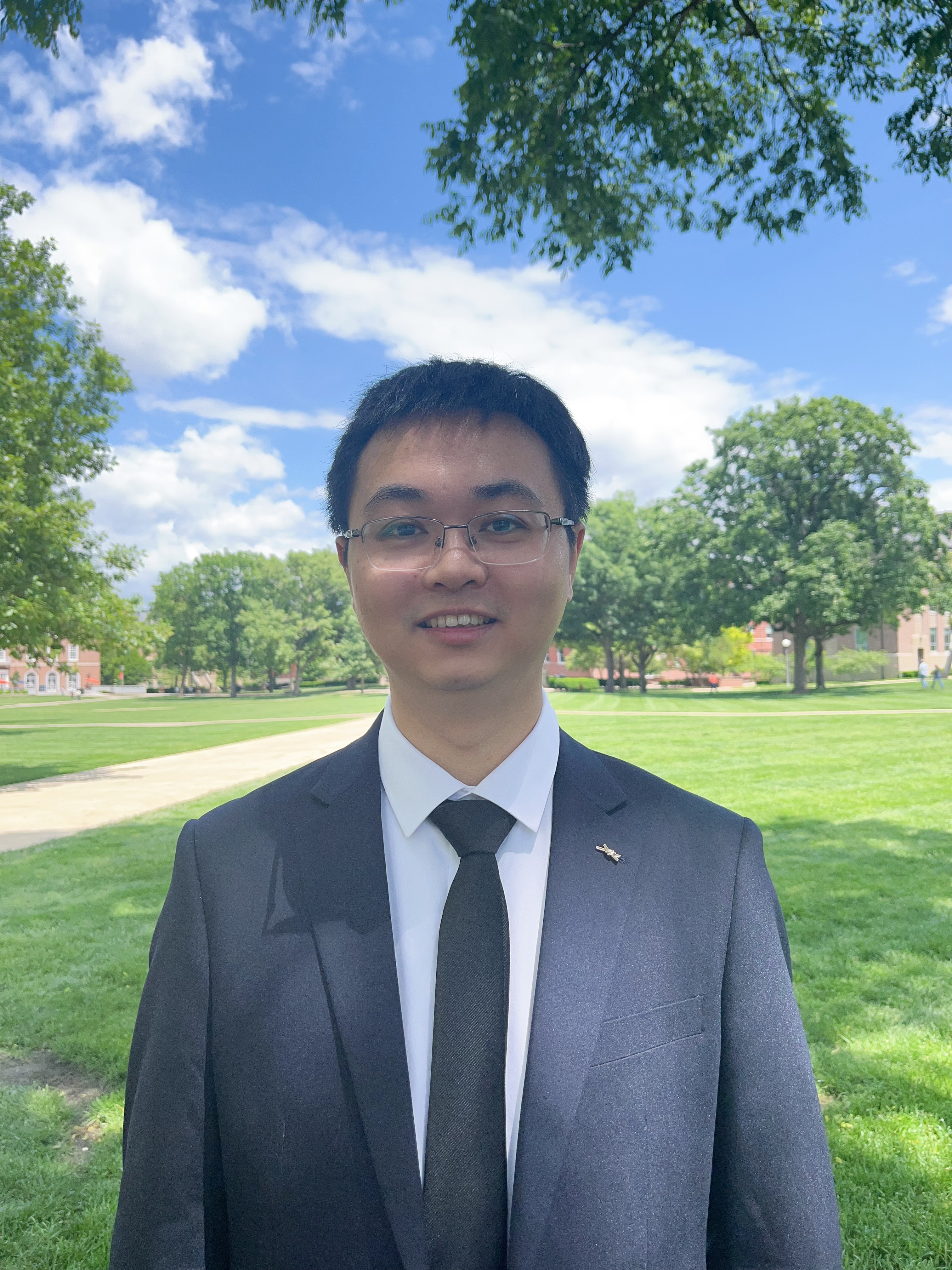
Tao Chen
PhD Candidate in Economics
University at Albany, SUNY
On the Job Market 2026-2027
Catskill 399, 1400 Washington Avenue, Albany, NY 12222
About
I am a PhD candidate in Economics at the University at Albany, SUNY, expecting to graduate in May 2027. My research develops econometric methods for analyzing time-varying economic relationships, with applications to macroeconomic forecasting and financial risk assessment.
My job market paper (with Zhongwen Liang) proposes a time-varying model averaging approach for quantile regression that adapts to changing economic conditions. I also collaborate with Karan Bhasin and Kajal Lahiri on translating PMI business surveys into practical forecasting tools.
Research Interests
Primary: Time Series Econometrics, Quantile Regression, Model Averaging, Machine Learning
Secondary: Macroeconomic Forecasting, Financial Economics, Health Economics
Dissertation Committee
Professor Zhongwen Liang (Co-Chair), Professor Kajal Lahiri (Co-Chair), Professor Ulrich Hounyo
Research
Job Market Paper
"Time-Varying Jackknife Model Averaging for Quantile Regression"
We propose a time-varying jackknife model averaging (TV-JMA) estimator for quantile regression that allows model averaging weights to adapt smoothly over time via local kernel estimation. A centering correction to the cross-validation criterion eliminates the bias from the non-zero conditional mean of the quantile regression error, enabling MSE-based weight selection. We establish convergence rates, asymptotic normality with diverging model dimensions, and asymptotic optimality of the selected weights under a scale-bias orthogonality condition that is automatically satisfied for median regression, pure location models, and heteroskedastic models with appropriately specified candidates. Monte Carlo simulations show that TV-JMA dominates constant-weight and constant-coefficient alternatives, with the gains increasing at tail quantiles and larger sample sizes. An empirical application to conditional quantile forecasting of excess stock returns and GDP growth-at-risk demonstrates the practical gains.
Working Papers
"Time-Varying Partially Linear Quantile Regression Under α-Mixing Conditions"
This paper develops estimation and inference for partially linear quantile regression with time-varying coefficients under α-mixing dependence. The model accommodates covariates with smoothly evolving effects alongside covariates with time-invariant effects, embedding the framework within Dahlhaus's local stationarity paradigm. I propose a three-stage estimation procedure based on local linear quantile regression: initial local estimation treating all coefficients as time-varying, averaging to obtain preliminary constant coefficient estimates, and re-estimation using partial residuals. I establish a Bahadur representation for the local estimator under mixing, prove √T-consistency and oracle efficiency for the constant coefficient estimator, and derive uniform convergence rates for the time-varying coefficient functions. For inference, I develop a supremum-type test for coefficient constancy with a block bootstrap that resamples (Y, X, Z) jointly to preserve the mixing dependence structure. Monte Carlo simulations demonstrate excellent finite-sample size control across all quantile levels and error structures, with good power against various alternatives. An empirical application to U.S. equity returns reveals significant time variation in market beta at lower quantiles, with risk exposure amplified during economic downturns.
"Quantile Regression Approach to Study Risk Heterogeneity in PMI as a Business Cycle Indicator"
In its monthly newsletter announcing the latest Purchasing Managers Index (PMI), the Institute of Supply Management (ISM) provides a breakeven value to suggest if the latest PMI value is indicative of continued growth or a recession. For instance, after being around 43.2 over last decade, this value has been revised to 47.5 since January 2026. Using U.S. real time macro data and partially linear time-varying quantile regression, we estimate PMI thresholds for predicting growth in Industrial Production (IP) and GDP growth. The median PMI thresholds for IP and GDP were found to be 49.5, and 43.5 respectively that varied very significantly across macroeconomic regimes since mid-80's. By estimating thresholds across conditional distributions of output growth using one-sided kernels, our cross-quantile variation quantifies the fundamental uncertainty in the PMI-output relationship and provides a principled framework for interpreting economic indicators. We provide fitted conditional quantile tables that translate any PMI reading into a probabilistic growth forecast, enabling practitioners to select thresholds appropriate for their risk tolerance, given all available information.
Work in Progress
"Conformalized Time-Varying Quantile Regression: Distribution-Free Prediction Intervals for Locally Stationary Processes"
"Jackknife Model Averaging for Partially Linear Time-Varying Coefficient Quantile Regression"
"“Time-Varying Quantile Regression of Real GDP Growth on the Leading Economic Index and Its Components” (with Kajal Lahiri)."
Publications
"Community Nursing on Subjective Well-Being of the Elderly: Evidence from CLASS Data"
BMC Nursing, 2025, 24(1), 757.
Teaching
🏆 Helen Horowitz Award for Exceptional Teaching by Graduate Students, 2024
Adjunct Lecturer
Oneonta College, SUNY
ECOn 1112: Principles of Macroeconomics
Fall 2026 (2 sections)
Instructor of Record
University at Albany, SUNY
AECO 301: Intermediate Macroeconomics
Summer 2023, Fall 2023 (2 sections), Spring 2024 (2 sections), Summer 2024, Fall 2024
AECO 320: Economic Statistics
Fall 2024, Spring 2025 (2 sections)
Teaching Assistant
University at Albany, SUNY
AECO 405/505: Game Theory
Professor Rui Zhao | Fall 2021, Spring 2022, Spring 2023
AECO 300: Intermediate Microeconomics
Professor Rui Zhao | Fall 2021, Spring 2022, Spring 2023
AECO 301: Intermediate Macroeconomics
Professor Yue Li | Fall 2022
Shandong University
Advanced Econometrics
Professor Jilin Wu | Fall 2018